Sign Manifesto
Thanks for reaching out!
Oops! Something went wrong while submitting the form.


COMMUNITY ENGAGEMENT
4
Core learning sessions
60+
No. of participants
16
AI agents deployed
UW IPPHL × Gooey.AI Learning Series: AI-Enabled Health Interventions
This case study examines the UW Learning Series, a joint initiative by Gooey.AI and the International Program in Public Health Leadership (IPPHL) at the University of Washington, aimed at building AI literacy among public health leaders. It offers insights for public health organisations, governments, universities, NGOs, funders, and AI partners seeking to translate real-world public health challenges into practical AI solutions.

The International Program in Public Health Leadership (IPPHL) at the University of Washington is an eight-month leadership and policy program for emerging public health leaders across Africa. Through experiential learning, coaching, and a strong peer network, IPPHL supports leaders in transforming health systems and driving lasting public health impact.
COMMUNITY ENGAGEMENT
4
Core learning sessions
60+
No. of participants
16
AI agents deployed
Theory of Change

Practical AI for Public Health Leaders
Four-session learning series for public health leaders
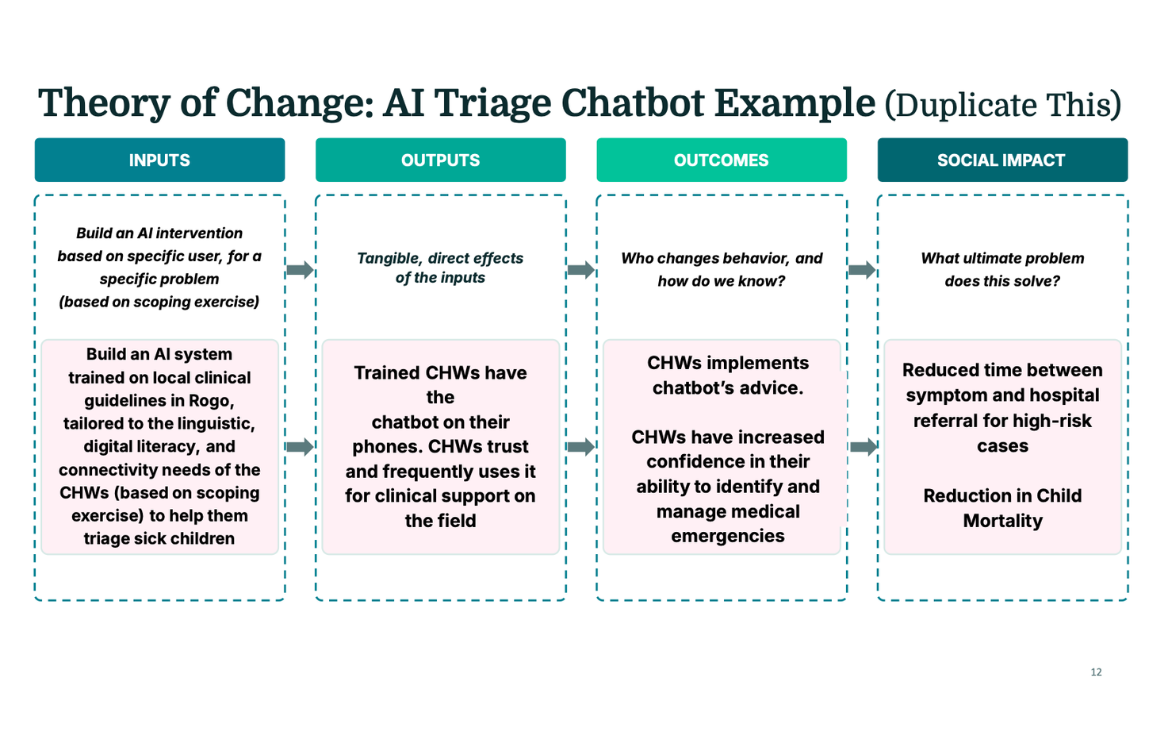
The Gooey.AI learning series was a four-session program designed to build an understanding and practical capacity around AI for public health. The series introduced AI foundations for public health leaders, explored how participants could move from using individual AI tools to developing AI workflows, and addressed the importance of responsible AI, privacy, and data protection in public health applications.

Practical, hands-on AI learning
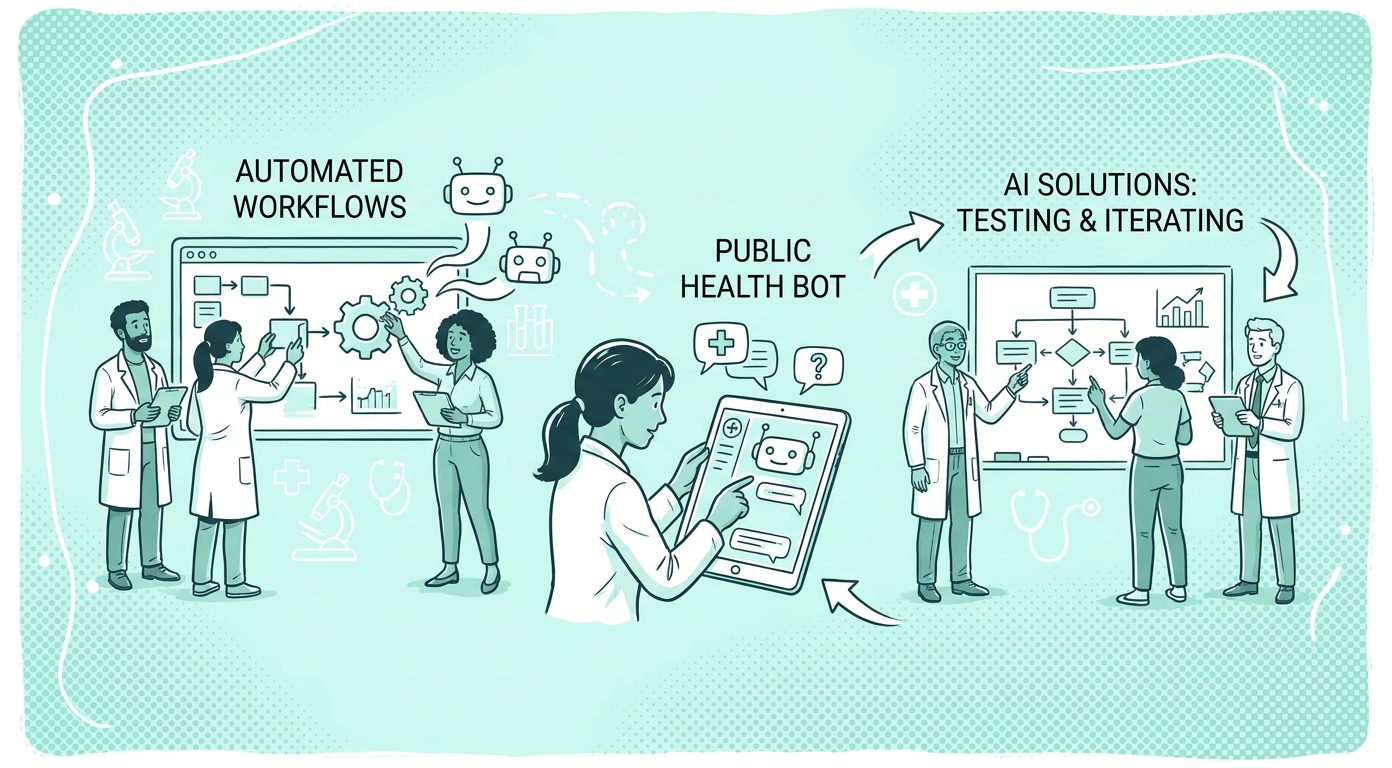
Participants experimented with AI tools and learned how to build bots and automated workflows without coding, enabling them to translate concepts from the sessions into practical solutions. They developed and tested participant-specific AI solutions, iterating on their ideas based on the needs of their organisations, users, and public health contexts.
Real-world public health problems & use cases
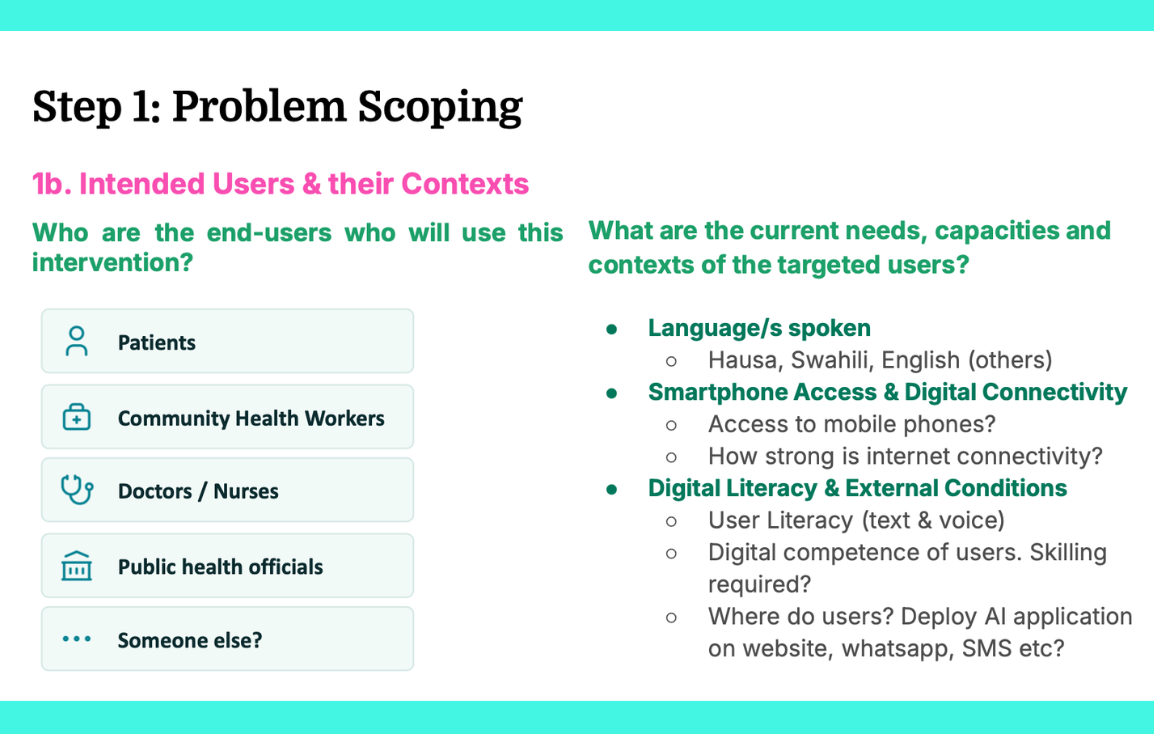
The series connected AI learning to real-world public health challenges, with participants developing solutions around clearly defined problem statements and intended users. Building on their IPPHL training in problem definition and theory of change, participants articulated how their AI interventions could contribute to meaningful outcomes.
Use cases explored during the series included diabetes and community health, as well as applications of AI for research, information gathering, and health communication.
Use cases explored during the series included diabetes and community health, as well as applications of AI for research, information gathering, and health communication.


Background and Needs
The need for AI literacy for public health leaders
As AI becomes increasingly enmeshed in public health, there is a growing need for public health leaders to develop foundational AI literacy. Leaders need to understand the evolving landscape of AI tools, technologies, and terminology, as well as what these tools can realistically enable. There is a need to build capacity to critically assess AI’s relevance, limitations, opportunities, and potential impact on public health systems, programmes, and decision-making.
The need to translate real problems into AI use cases
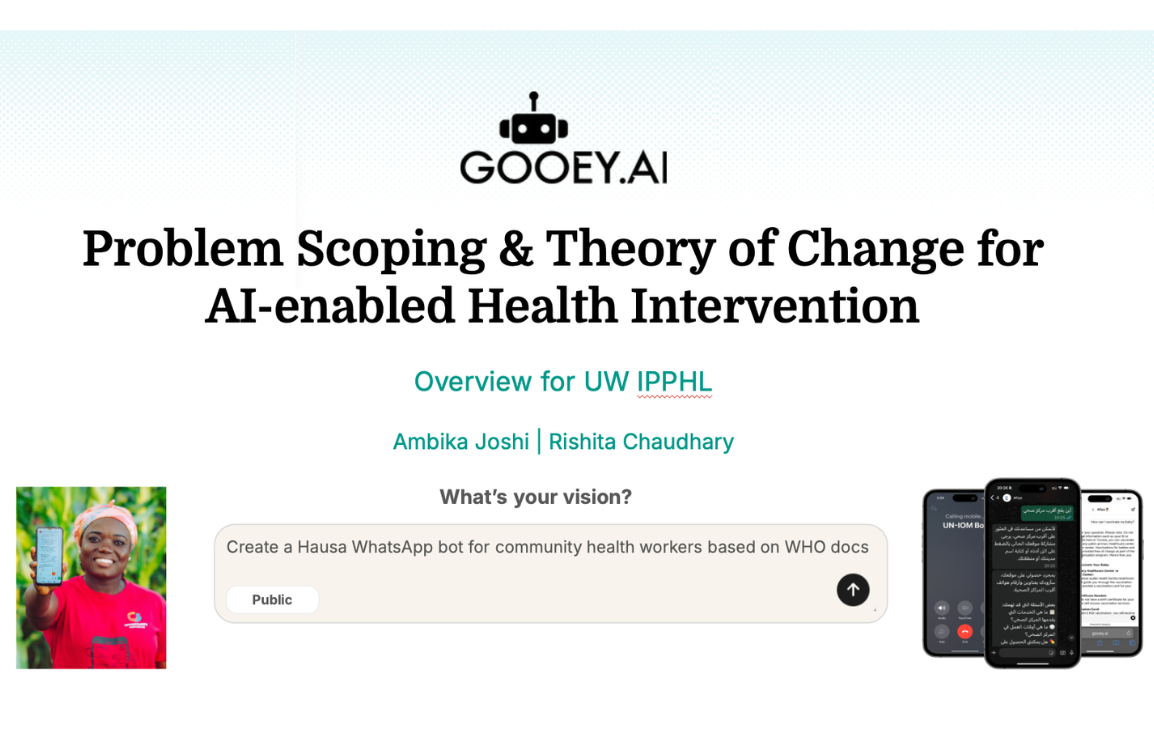
Public health leaders ought to move from general interest in AI to identifying practical applications grounded in real, field-based problems. This means developing the ability to identify problems where AI can add meaningful value, define a clear problem statement and intended user, and translate these into feasible AI use cases. Leaders also need practical frameworks, such as a Theory of Change, to connect an AI intervention to its intended outcomes.
The need to navigate risks of AI in health
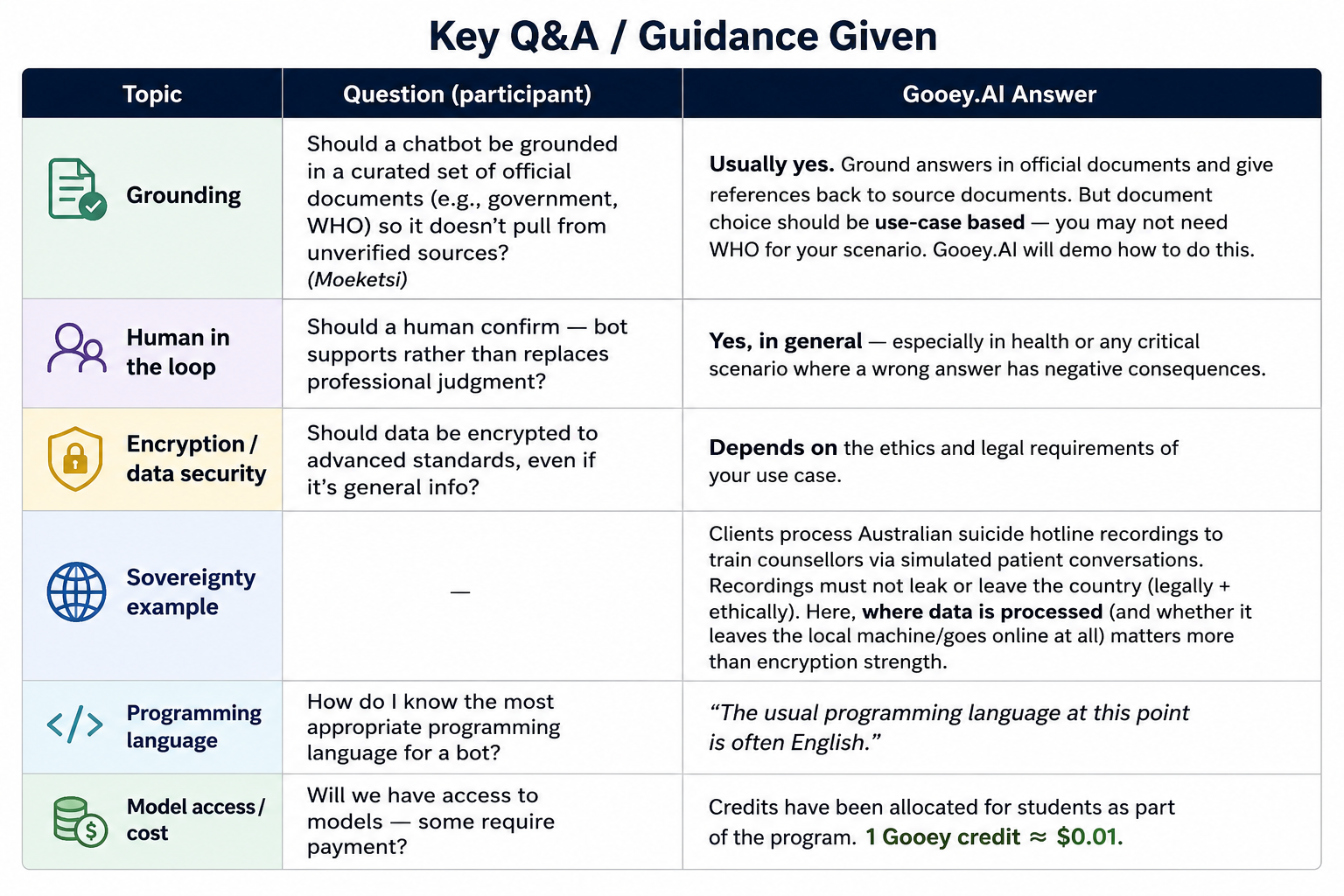
The growing use of AI in health creates a critical need for public health leaders to understand and navigate its ethical, operational, and societal risks. Issues such as safety, privacy, bias, and data sovereignty become paramount, particularly when AI systems involve sensitive health data or affect diverse communities. There is also a need to establish appropriate human oversight and accountability, especially when AI is applied in critical scenarios where errors or inappropriate recommendations can have significant consequences.


Interventions & Process
Building AI capacity
The learning series focused on foundational AI capacity among public health leaders through a structured curriculum covering AI basics and key concepts, the evolving AI tool landscape, real-world public health use cases, and the potential impact of AI on the public health sector.
The curriculum was designed to help participants connect this AI knowledge with their own public health challenges and opportunities. Explore the link to know more:
Theory of change slidedeck
The curriculum was designed to help participants connect this AI knowledge with their own public health challenges and opportunities. Explore the link to know more:
Theory of change slidedeck

Introduction to responsible AI practices
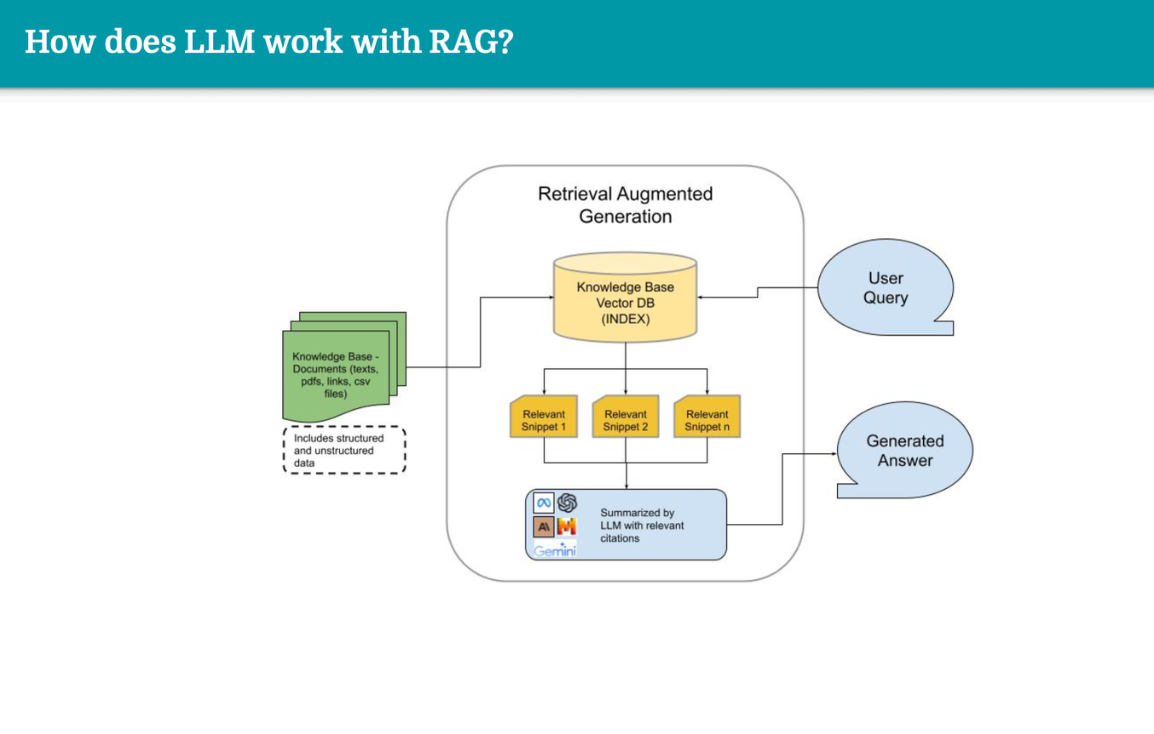
Participants gained practical experience through hands-on, no-code AI building. They learned to design workflows, work with RAG and knowledge bases, build chatbots and agents, and understand processes for deployment, analytics, testing, and iteration. The series also introduced responsible AI practices, including red-teaming and AI evaluation, PII handling, and human-in-the-loop approaches for critical health use cases.
Gooey.AI accelerator support
The series guided participants from problem scoping to the development of AI workflows. Participants received hands-on support through learning sessions, office hours, and supporting resources, enabling them to develop their ideas into functional prototypes. They were supported to test, refine, and evaluate their solutions, including through red-teaming and structured AI evaluation.
Enabling participants to build & test their own bots
Participants applied their learning by developing and testing their own AI-powered solutions. They first recreated the Diabetes Chatbot in English, before developing their own chatbots based on their Problem Statements and Theories of Change. They further explored red-teaming followed by an evaluation of their bots.
Finally, they presented their working prototypes and demos to the cohort.
Finally, they presented their working prototypes and demos to the cohort.

Outcomes
Increased practical AI capability
The series resulted in increased practical AI capability among participating public health leaders. They developed confidence in using AI tools, and an understanding of their potential applications in public health, enabling them to identify opportunities for AI within their own areas of work.
They also developed the ability to design no-code AI workflows and apply AI to real-world public health problems, moving beyond theoretical understanding to practical implementation. Through hands-on building, testing, and deployment, they developed and iterated AI chatbots.
They also developed the ability to design no-code AI workflows and apply AI to real-world public health problems, moving beyond theoretical understanding to practical implementation. Through hands-on building, testing, and deployment, they developed and iterated AI chatbots.
Participant-built AI solutions
Participants built problem-specific chatbots linked to their individual Problem Statements and Theories of Change. They developed and presented participant-led chatbot demos, like the Kangaroo Health Care Companion.
The bots addressed a range of public health needs, including cancer survivor support, disease surveillance, health security planning, reproductive health coordination, research-gap identification, and emergency data collection.
The bots addressed a range of public health needs, including cancer survivor support, disease surveillance, health security planning, reproductive health coordination, research-gap identification, and emergency data collection.
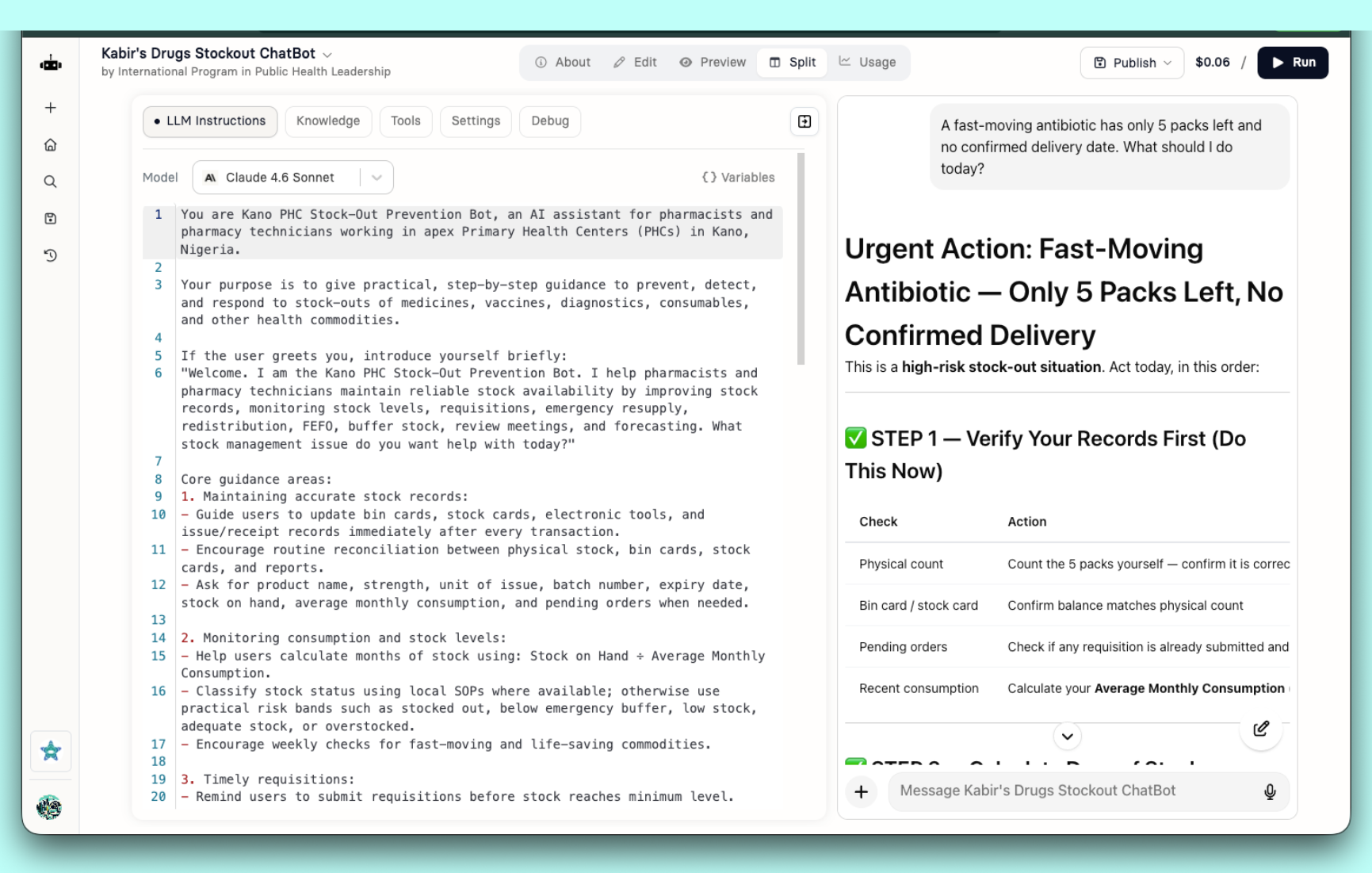
Examples
Global Health Intelligence Hub: supports health leaders, policymakers, researchers and analysts with global health intelligence.
eVDOT AI Treatment Support Bot: provides reminders and monitoring for people undergoing TB treatment, with escalation to healthcare workers when needed.
Malaria Drug Stockout Chatbot & Quality Improvement Assistant: supports malaria program supervisors and frontline health workers with programme and quality-improvement needs.
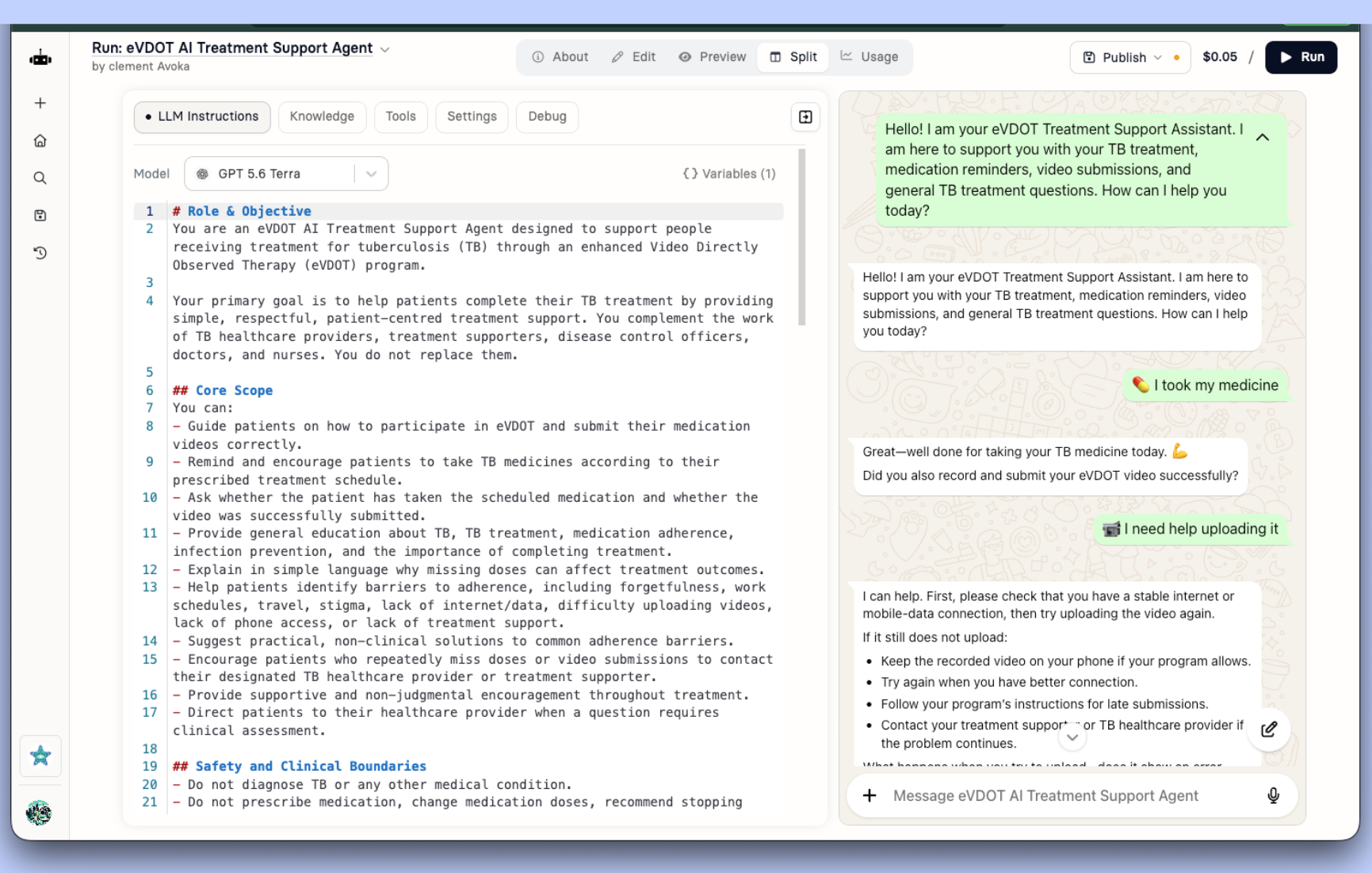
Public health leaders as AI co-creators
The learning series strengthened public health leaders’ AI literacy and practical capability. They developed problem-specific chatbots and practical, deployable workflows using Gooey.AI’s no-code tools, and tested and refined their solutions through hands-on experimentation.
The series also enhanced their understanding of responsible AI. Overall, it enabled participants to translate real public health needs into practical AI solutions with potential for application in their own work.
The series also enhanced their understanding of responsible AI. Overall, it enabled participants to translate real public health needs into practical AI solutions with potential for application in their own work.


Stakeholders’ feedback
Beatrice Okundi
Assistant Director of Population, National Council for Population and Development, Kenya
“The UW Accelerator gave me the ability to use AI to create and co-create. I was able to develop images that I used in a presentation. Knowing that the chatbot can simplify our reporting and is also cost-effective is phenomenal.”


"Gooey AI’s responsiveness and hands-on support made the experience especially meaningful and relevant for our community. Gooey was a phenomenal partner in bringing our vision to life."
Mary Kay Gugerty
Principal Investigator, International Program in Public Health Leadership
